
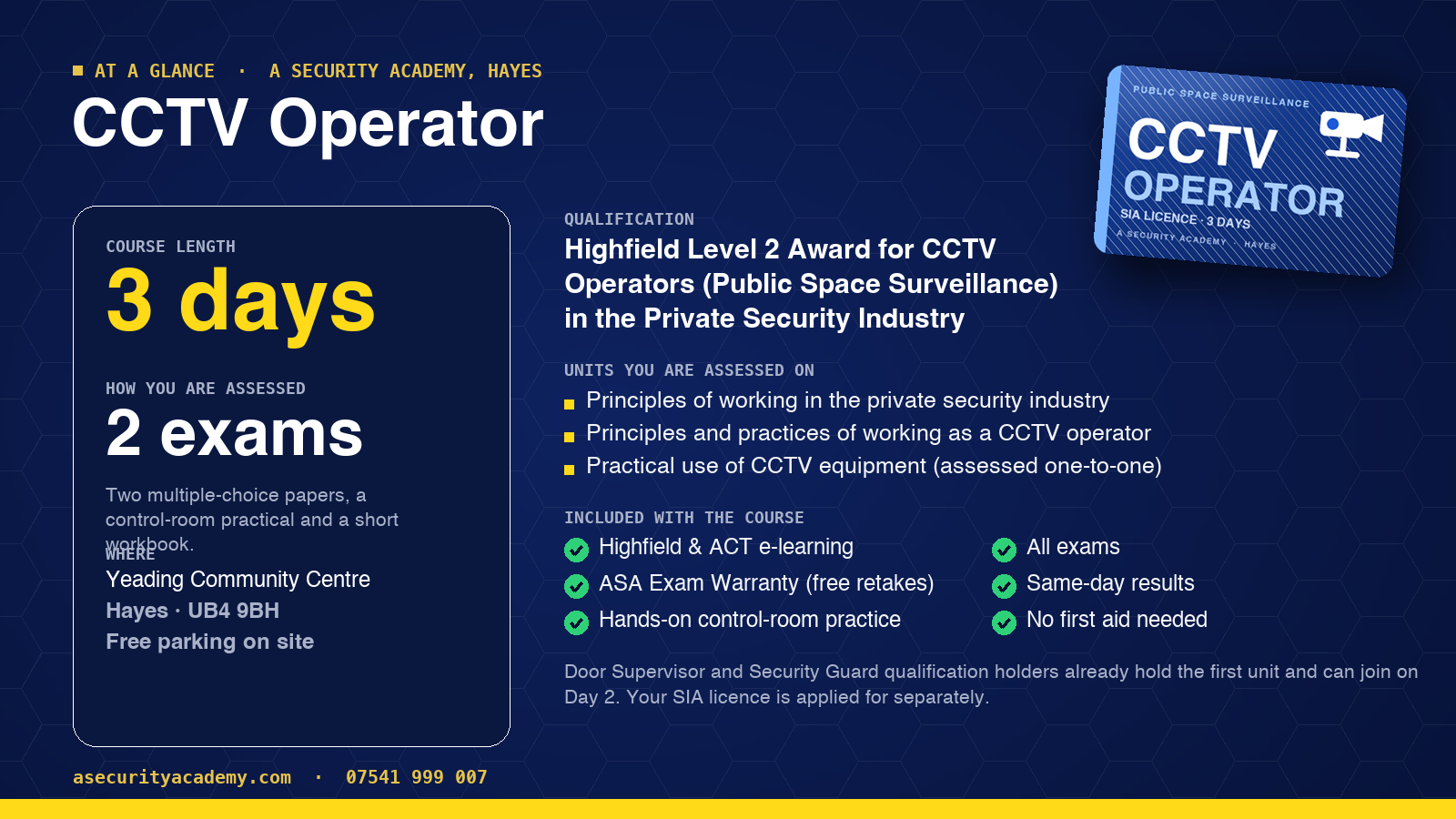
CCTV is the licence for control rooms and monitoring: watching public spaces, directing staff on the ground, spotting incidents before they grow and producing footage that can be used as evidence. It is a three-day course with us, two days if you already hold a Door Supervisor or Security Guard qualification gained under the 2021 specification, and there is no first aid requirement. This guide covers what the licence is for, what the qualification contains, how it is assessed and what to have ready. Dates and current prices are on the calendar.
What a CCTV Operator licence covers
The SIA's CCTV licence is for public space surveillance: using CCTV to monitor members of the public or to identify people, in a control room, monitoring station or mobile unit. Typical roles are shopping centre and town centre control rooms, transport hubs, large sites and events, and monitoring stations for alarm and security companies.
You do not need the licence to be a security guard who glances at a camera screen on reception. You do need it if monitoring and directing from the cameras is your job. If you want to move into control-room work from the door or from guarding, this is the route.
Who it suits, and the two-day route
Anyone with English at the SIA's required level, equivalent to B2 on the Common European Framework or ESOL or Functional Skills Level 1, can take the full three-day course. The qualification can be delivered from 16, but the SIA will not issue a licence until you are 18. There is no first aid requirement for CCTV.
The first unit of the CCTV qualification, Principles of working in the private security industry, is the same unit, with the same exam and the same evidential statement, as in the Door Supervisor and Security Guard qualifications introduced in April 2021. If you hold one of those you have already passed it, so you join on Day 2, skip Unit 1 entirely and sit only the CCTV unit. Bring your original certificate so we can confirm it. A door supervisor qualification from before April 2021 does not contain this unit, so you would take the full course. Send us a photo of your certificate before you book if you are unsure.
What the qualification contains
The qualification is the Highfield Level 2 Award for CCTV Operators (Public Space Surveillance) in the Private Security Industry, qualification number 603/5534/7, with 30 guided learning hours and a minimum of 20 hours of classroom contact where supported self-study is used for part of Unit 1. It has two units.
| Unit | What it covers | How it is assessed |
|---|---|---|
| 1. Principles of working in the private security industry | The law, the SIA and licensing, your responsibilities, health and safety, fire and emergency procedures, communication, record keeping, terror threats, keeping vulnerable people safe, post-incident management | 72-question exam, 110 minutes, plus a written evidential statement |
| 2. Principles and practices of working as a CCTV operator | The purpose of surveillance systems and the control room team, the legislation that governs CCTV (data protection, human rights, RIPA, the Surveillance Camera Code), operational procedures and audit trails, how the equipment works, surveillance techniques, incident response, health and safety in the control room, practical use of the equipment and producing evidential documentation | 40-question exam, 60 minutes, a six-question workbook, and a filmed one-to-one practical on the control-room equipment of about 25 minutes |
Every part of every unit must be passed. The detail is in the CCTV exam guide and the CCTV practical guide.
The control room
The specification requires the CCTV unit to be taught and assessed in a control room with at least two pan-tilt-zoom cameras and the recording and monitoring equipment that goes with them, or a simulated control room used only for that purpose. You get real time on the controls before you are assessed: functional checks, camera handling, tracking across cameras, capturing an evidential image and completing the audit trail. That hands-on time is where the course earns its value, because it is exactly what a control-room employer will ask you about.
The three days
The course runs at Yeading Community Centre, 2 Ditchfield Road, Hayes, UB4 9BH, with free parking. Each intake on the calendar has a "View full schedule" button with day-by-day times and the Day 1 requirements. Both units must be taught before you take the one-to-one practical, so the practical and the CCTV exam fall at the end of the course.
E-learning before Day 1
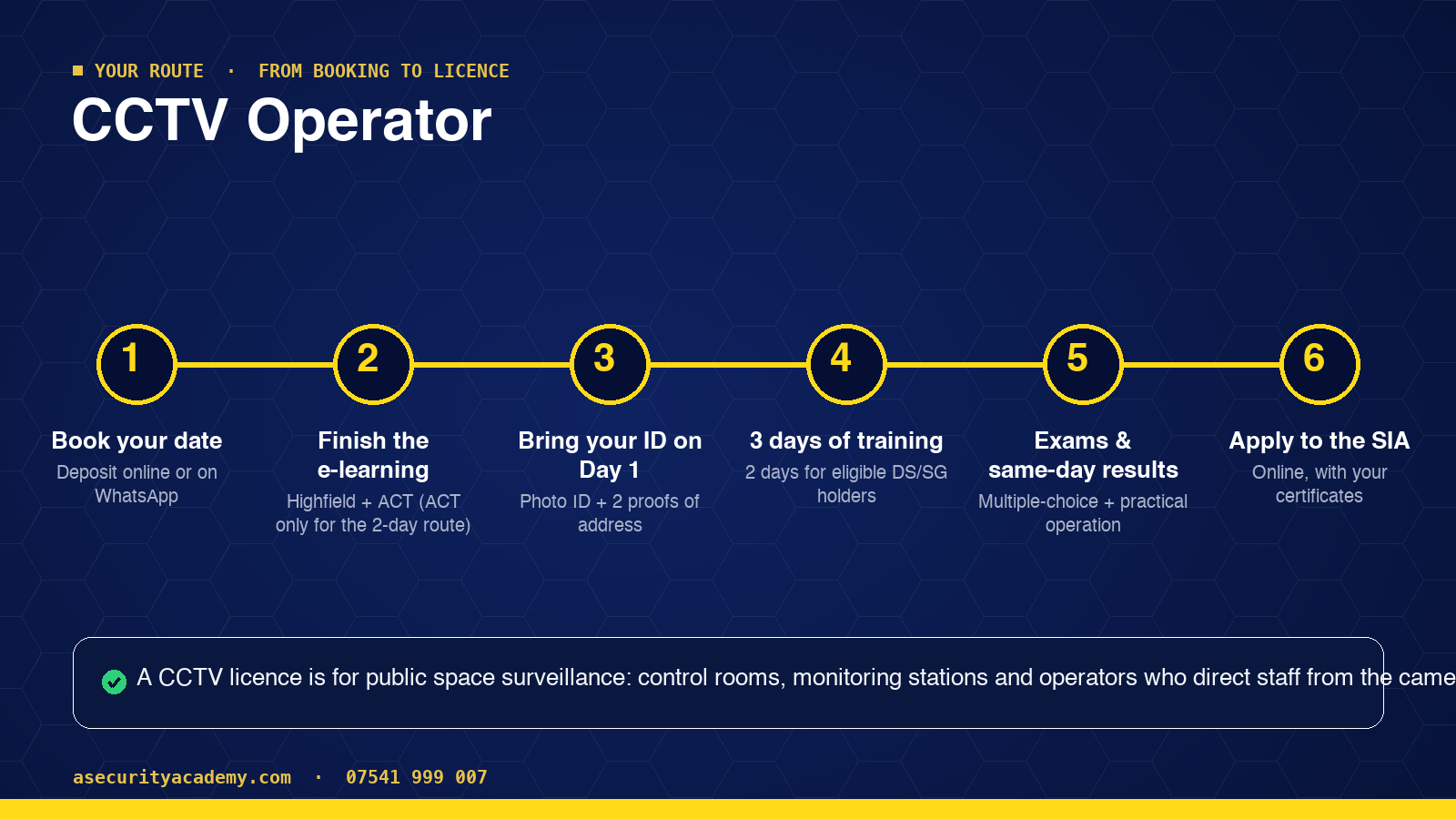
- Three-day route: Highfield Security e-learning (login sent after you book) plus the two free ProtectUK courses, ACT Security and ACT Awareness. No first aid e-learning.
- Two-day route for DS and SG holders: ACT Security and ACT Awareness only.
Download the certificate PDF for each course, email them to us before the course and bring digital copies on the day. The e-learning page shows each step with screenshots.
What to bring on Day 1
- Photo ID: an in-date passport or UK driving licence (provisional accepted).
- Two proofs of address from two different organisations, each dated within the last three months, with your name and address matching across all documents.
- Your e-learning certificates, and your DS or SG certificate if you are on the two-day route.
Without the required ID and ACT certificates you cannot join the course. See the Day 1 checklist.
Exams and results
The exams are multiple-choice papers set and marked by Highfield, sat under exam conditions, with results the same day. The workbook and the practical are assessed in the room. Use the free mock exams before you come. If you do not pass an exam first time, the ASA Exam Warranty covers your next two attempts at no extra cost, provided you attend, take part and book your retake promptly.
Applying for your licence
The course fee covers training and assessment. The CCTV licence is applied for through your own SIA online account and paid directly to the SIA; the current fee and documents are on the SIA's apply for a licence page, and the licence lasts three years. Our guides to creating an SIA account and contacting the SIA cover the rest. Apply as soon as your certificate is issued.
FAQ
Do I need first aid for the CCTV course?
No. The SIA's first aid requirement applies to Door Supervisor and Security Guard training, not CCTV.
I have a Door Supervisor licence. Do I have to do all three days?
If your Door Supervisor or Security Guard qualification was gained under the April 2021 specification you have already passed Unit 1, so you join on Day 2. Send us a photo of your certificate if you are unsure.
Does a CCTV licence let me do guarding work?
No. Each SIA licence covers its own role. Many operators hold both a CCTV licence and a Door Supervisor or Security Guard licence.
Is the practical assessment difficult?
Not if you use the practice time on the equipment. You are assessed on functional checks, camera handling, tracking, capturing an evidential image and completing the audit trail, which is exactly what we practise.
Ready to book your course?
Current prices and dates are on our calendar. Everything about A Security Academy, the SIA-approved training centre in Hayes, West London, is on the home page.