
The Door Supervisor licence is the one most people in security should get first. It lets you work on the door at pubs, clubs and events, and it also covers security guarding, so you are never locked out of static, retail or corporate work later. This guide is what I tell every learner before they book with us in Hayes: who the licence is for, what the qualification actually contains, how each unit is assessed, what you must have ready before Day 1 and what happens after you pass. Course dates and current prices are on our calendar; this page is about the procedure.
Who the Door Supervisor licence is for
A door supervisor is the person responsible for safety and entry at licensed premises: checking ID and entry conditions, managing queues, refusing entry when it is the right call, searching with consent, dealing with conflict, keeping vulnerable people safe and, when there is no other option, using approved physical intervention to protect people. The Security Industry Authority (SIA) licenses the role under the Private Security Industry Act 2001.
Because the training goes further than the Security Guard course, a Door Supervisor licence also allows you to work in security guarding. The reverse is not true: a Security Guard licence does not let you work on the door of a licensed venue. If you are new to the industry and not sure where you will end up, this is the licence I recommend.
What you need before you book
- Be 18 or over. The Door Supervisor qualification is only open to learners aged 18 and over, and the SIA will not licence anyone younger.
- English at the SIA's required level. You must be able to read, write, speak and listen well enough to follow the training, sit the exams and, in the job, call the emergency services or talk someone down. The qualification specification sets this at the equivalent of B2 on the Common European Framework, or an ESOL Level 1 or Functional Skills Level 1 in English. Training centres are required to check this before training, and we do it when you book.
- A valid first aid certificate before the security training starts. The SIA requires everyone taking Door Supervisor training to hold an Emergency First Aid at Work qualification, or an equivalent that meets the Health and Safety Executive's guidance, with at least 12 months left on it from the course start date. Our course builds the Highfield Level 3 Emergency First Aid at Work day into the week, and it is completed and passed before the practical security training begins, which is exactly how the awarding body requires it to be sequenced.
- The right to work in the UK and documents that prove your identity. The SIA checks both when you apply for the licence, and we check your ID on Day 1.
You do not need any previous security experience.
What the qualification contains
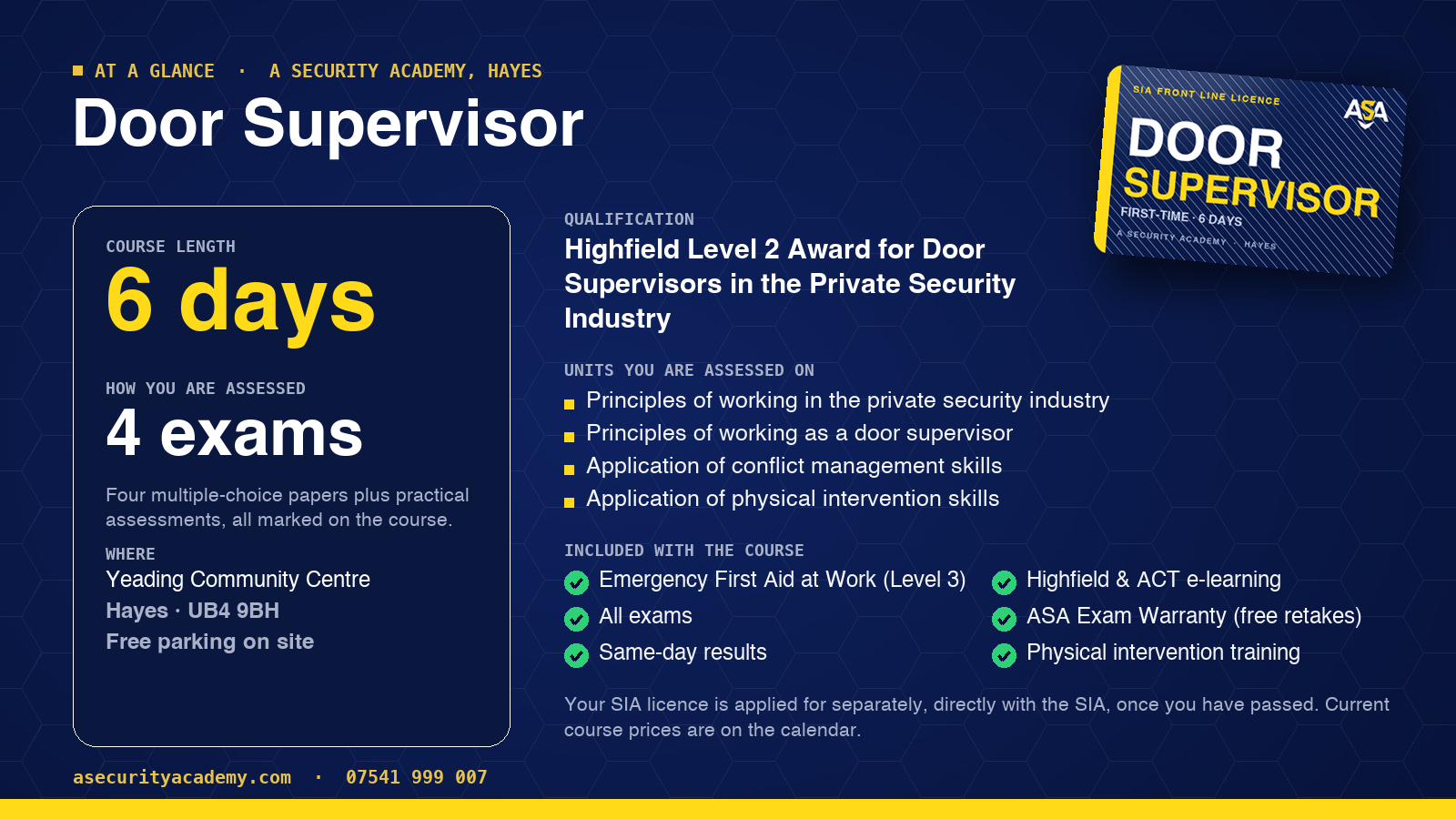
The qualification is the Highfield Level 2 Award for Door Supervisors in the Private Security Industry, qualification number 603/5531/1. It is the SIA licence-linked qualification, built on the SIA's own specification for learning, and it has four mandatory units. Every unit has a multiple-choice exam and a practical assessment, and you must pass every part of every unit.
| Unit | What it covers | How it is assessed |
|---|---|---|
| 1. Principles of working in the private security industry | The law, the SIA and licensing, your responsibilities, health and safety, fire and emergency procedures, communication and customer service, record keeping, terror threats and the operative's role, keeping vulnerable people safe, post-incident management | 72-question exam, 110 minutes, plus a written evidential statement |
| 2. Principles of working as a door supervisor | Licensing law and licensed premises, entry conditions and refusals, drugs awareness, search procedures, dealing with incidents and crime scenes, recording, queue control, vulnerable people and safeguarding | 50-question exam, 75 minutes, plus a filmed search and communications practical |
| 3. Application of conflict management | Recognising, assessing and reducing risk in conflict, problem solving, communicating to de-escalate, working with colleagues, post-incident | 20-question exam, 30 minutes, plus a filmed conflict scenario |
| 4. Application of physical intervention skills | The law and risks of physical intervention, positional asphyxia and acute behavioural disturbance, stance and positioning, evading blows, disengaging from grabs and holds, non-aggressive intervention, prompting, escorting holds, stairways, disengaging and managing risk afterwards | 30-question exam, 45 minutes, plus a filmed demonstration of every technique and a question-and-answer session |
Unit 1 is shared with the Security Guard and CCTV qualifications. That is why a Door Supervisor qualification holder can take the CCTV course on a shorter route later.
I have written a separate, detailed guide to the Door Supervisor exams (question counts, timings, pass marks and how to revise) and another to the practical assessments (what you are asked to do in the room and how the assessor marks it).
How the training is structured
The awarding body sets a minimum of 52 guided learning hours for this qualification. Where part of Unit 1 is covered by supported self-study, which is what your Highfield e-learning is, the minimum classroom contact time is 42 hours over at least 6 days. That is why the course is six days with us: it is the minimum the SIA allows, not a choice we made to save time.
The order is fixed by the specification as well. You are trained in conflict management before you do the Unit 2 practical and before any physical intervention training, because the whole point of the physical skills is that they are the last resort after communication has failed. The first aid day comes before the practical security training. Each unit's exam is sat under exam conditions with an invigilator who did not teach you that unit.
The course runs at Yeading Community Centre, 2 Ditchfield Road, Hayes, UB4 9BH, with free parking on site. Each intake on the calendar has a "View full schedule" button with every day's start, finish and breaks. Bring comfortable clothes you can move in for the physical intervention days; you will be on your feet.
Before Day 1: the e-learning is not optional
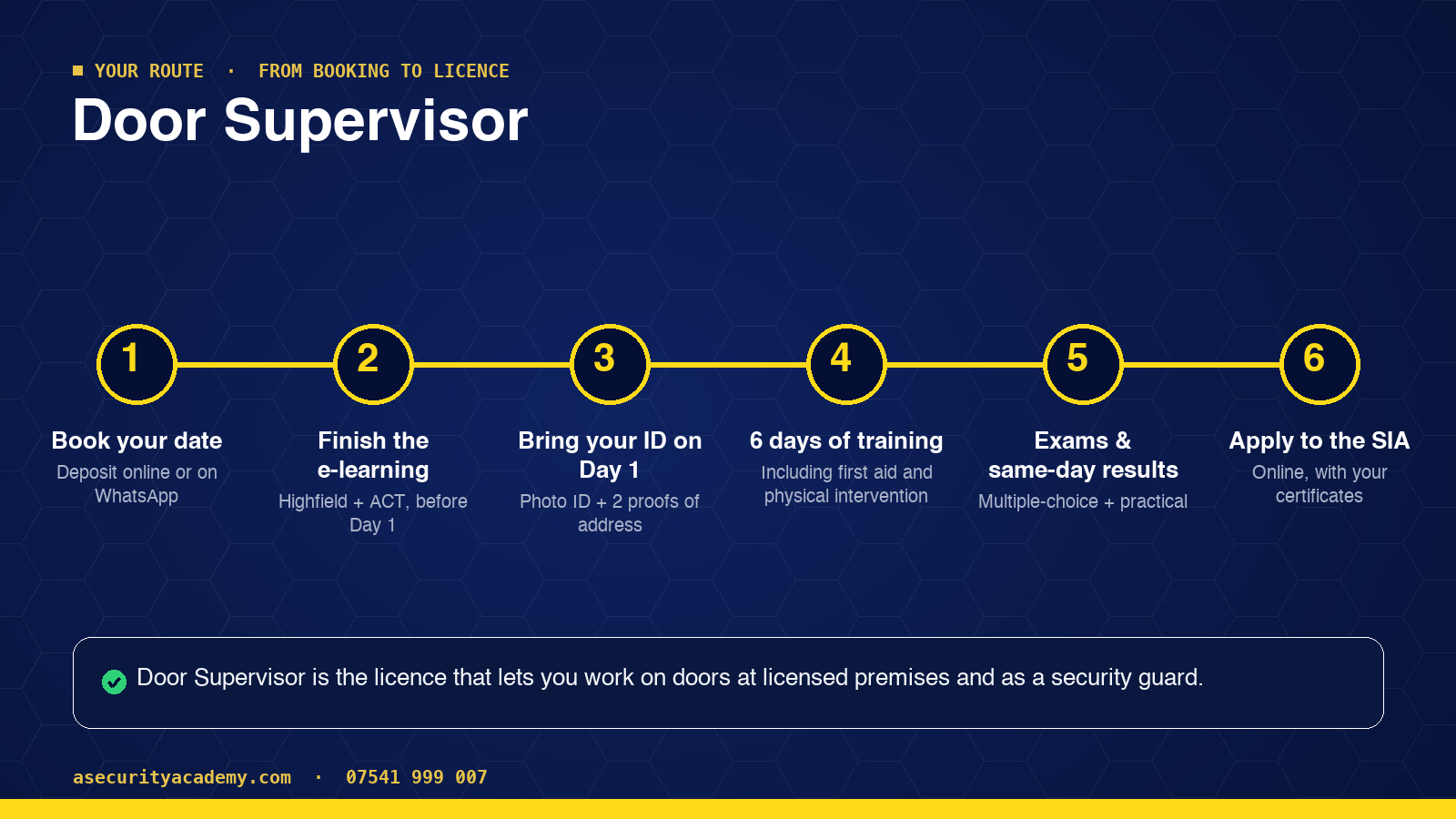
This is where most delays happen, so I will be blunt: no e-learning, no course. The e-learning is the supported self-study that the awarding body allows for part of Unit 1, and the SIA requires centres to evidence it. You must finish four online certificates before you walk in on Day 1.
- Highfield Security e-learning. You get a Highfield learner login from us after you book. Use the Learner login, not the Admin login. Complete every module until it shows 100 per cent and download the certificate PDF.
- Highfield First Aid e-learning. Same login, separate course and separate certificate. It prepares you for the first aid day.
- ACT Security on ProtectUK, the free police counter-terrorism e-learning. Create your own account at protectuk.police.uk, complete the course and download the certificate.
- ACT Awareness on ProtectUK. A separate course with its own certificate.
Our e-learning page walks through each one with screenshots and a checklist that saves your progress. Email all four certificates to us before the course and bring digital copies on the day.
What to bring on Day 1
- Photo ID: an in-date passport or UK driving licence. A provisional licence is fine.
- Two proofs of address from two different organisations, each dated within the last three months: a utility bill, bank statement or council tax letter, for example.
- Your name and address must match on every document, and they should match what you will put on your SIA application later. A spelling difference between your ID, your certificate and your SIA account is the most common reason a qualification "does not show" on the SIA system.
- Your e-learning certificates (digital is fine).
If you arrive without the required ID or ACT certificates you cannot join the course. Our information page has the full Day 1 checklist and a readiness tracker.
Exams and results
Each unit has its own multiple-choice paper, externally set and marked by Highfield, sat under exam conditions. We run the exams digitally and give you your results the same day. The papers vary between learners, so there is no shortcut other than knowing the material. Use our free mock exams for every unit before you come, and read the exam guide for the timings and the pass marks.
If you do not pass a paper first time, the ASA Exam Warranty covers your next two attempts at that exam at no extra cost, provided you attend, take part and book your retake promptly.
After you pass: applying for the licence
Your course fee covers the training and assessments. The licence itself is applied for and paid for directly with the SIA, through your own SIA online account. The current application fee and the documents you need are on the SIA's apply for a licence page, and a licence lasts three years. Our step-by-step guide to creating an SIA account and applying covers the process, and the SIA contact guide explains what to do if your qualification does not appear on your account straight away.
The SIA runs identity and criminal record checks, and it cannot say in advance how long an application will take, so apply as soon as your certificate has been issued.
FAQ
Does the Door Supervisor course include the SIA licence?
No. The course covers training, exams, first aid and e-learning. Once you have passed, you apply for your licence directly with the SIA and pay their fee to them.
Can I work as a security guard with a Door Supervisor licence?
Yes. The Door Supervisor licence covers security guarding as well as door work at licensed premises. A Security Guard licence does not cover door work.
Do I need first aid before the course?
Yes. The SIA requires an Emergency First Aid at Work qualification, or equivalent, valid for at least 12 months from the course start date, before you take the security training. Our course includes the first aid day and it is completed first.
How long does the course take?
Six days, which is the minimum the SIA allows where e-learning is used for part of Unit 1. The exact timings for each intake are on the calendar.
When do I get my results?
Multiple-choice results are given on the same day. Practical assessments are marked in the room. If the awarding body's system has a technical issue, results follow the next working day.
Ready to book your course?
Current prices and dates are on our calendar. Everything about A Security Academy, the SIA-approved training centre in Hayes, West London, is on the home page.